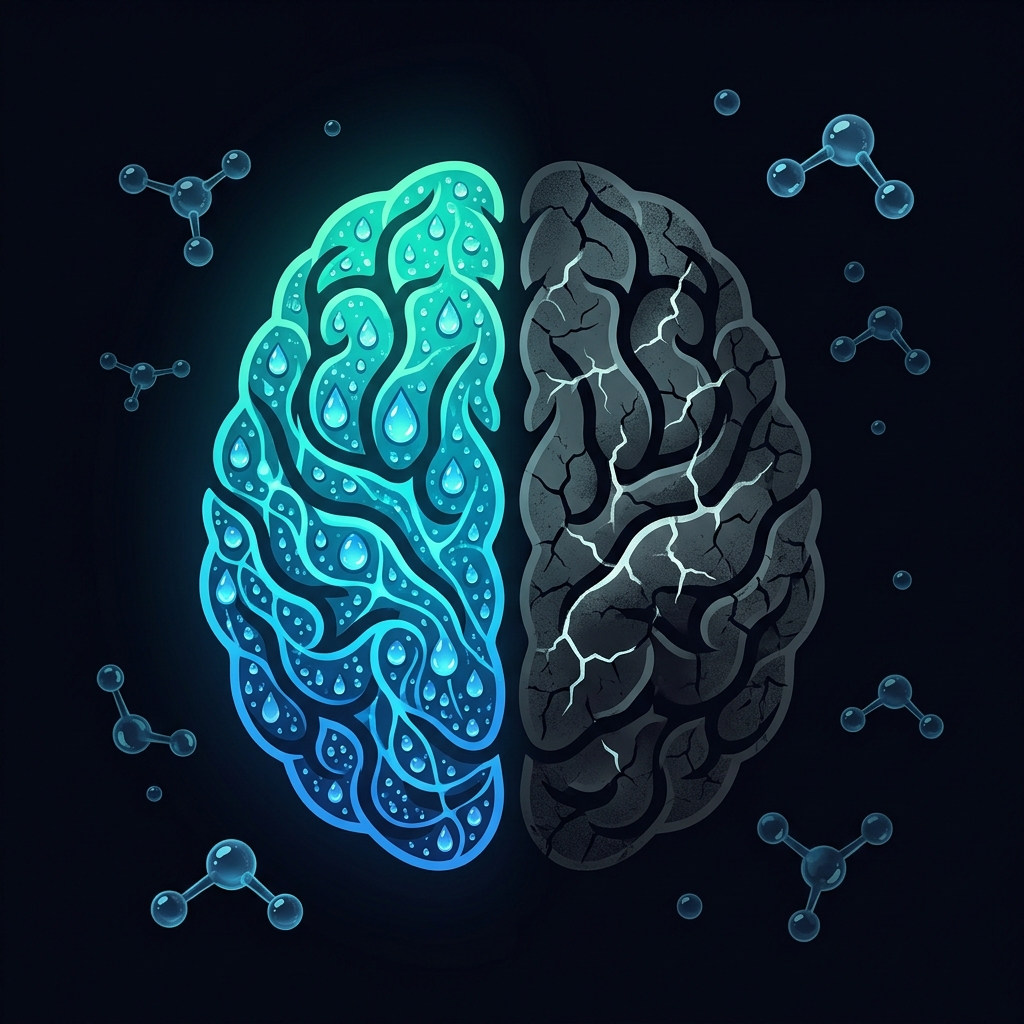
Here's a question: when was the last time you drank water? If you have to think about it, there's a good chance your brain is already operating below capacity. The insidious thing about dehydration is that cognitive impairment begins before you feel thirsty.
The 33-Study Meta-Analysis
A comprehensive meta-analysis of 33 studies including 413 participants found that dehydration corresponding to more than a 2% reduction in body mass was associated with significant impairments across three critical cognitive domains:
• Attention — Your ability to focus and filter distractions degrades. • Executive function — Decision-making, planning, and complex reasoning decline. • Motor coordination — Physical precision and reaction time suffer.
To put that 2% in concrete terms: for a 150-pound person, that's just 3 pounds of fluid loss. On a hot day, during exercise, or simply from forgetting to drink during a busy morning, you can hit that threshold faster than you think.
Why You Can't Trust Thirst
The body's thirst mechanism is a lagging indicator. By the time you feel thirsty, you're already mildly dehydrated — meaning the cognitive effects are already in play.
This creates a particularly dangerous feedback loop for knowledge workers. You're deep in a project, fully focused, ignoring physical signals. By the time you break for water, your attention and executive function have been degraded for potentially hours. The work you produced during that window was done with a handicapped brain, but you had no way of knowing.
Studies show that even 1% dehydration can increase feelings of anxiety and fatigue — both of which further impair the concentration needed for complex work.
The Performance Stack
Hydration doesn't exist in isolation. It interacts with every other biological lever:
• Sleep quality degrades when you're dehydrated. Your body can't regulate temperature as effectively, disrupting the 2–3°F core temperature drop needed for deep sleep.
• HRV drops with dehydration. Lower heart rate variability means your body is under stress — reducing readiness and making flow state harder to access.
• Exercise performance falls by up to 25% at moderate dehydration levels, reducing the movement stimulus your circadian rhythm depends on.
• Fasting becomes harder because hunger and thirst signals get confused. Many people break fasts early because they're actually just dehydrated.
Hydration is the cheapest, simplest lever in the entire performance stack — and it's the one most people neglect.
A Simple Protocol
The research suggests a straightforward approach:
1. Front-load your hydration. Drink 16–20 oz within the first hour of waking. You lose significant fluid during sleep through respiration and perspiration.
2. Set interval reminders. Don't rely on thirst. Drink consistently every 60–90 minutes throughout the day.
3. Monitor the signals. Urine color is a practical proxy — pale yellow indicates adequate hydration; dark yellow means you're already behind.
4. Track it. What gets measured gets managed. The days you forget to hydrate are the days your cognitive output suffers most — and you won't notice the connection without data.